Convenient, Anytime, Light Fitness
Start with something obvious: what decides whether most people move is usually not “do I want to be healthy” but how large the overhead is.
Change clothes, walk twenty minutes to the gym, queue for equipment, walk back, shower — the actual exercise might be forty minutes, but you have to free up two hours for it. Very few two-hour blocks in a year come free, and so the annual membership becomes a receipt in a drawer.
The World Health Organization recommends 150–300 minutes of moderate activity per week, or 75–150 minutes of vigorous activity. But two newer findings mean “I cannot fit in one continuous block” is no longer an excuse.
First, short counts now
In 2020 the WHO updated its physical activity guidelines and removed the requirement that a bout last at least 10 minutes — because there is no evidence that exercising for ten minutes at once is better than several shorter bouts. The US had made the same change in 2018.
In other words, a few minutes is no longer “activity that does not count”. It adds up toward your weekly total.
Behind that is a body of research on exercise snacking: spreading short bursts of activity across the day like snacks. In one study of inactive adults, three 20-second cycling sprints a day produced roughly a 9% improvement in cardiorespiratory fitness over several weeks — comparable to doing the same three sprints inside a single ten-minute window. Another study had participants climb three flights of stairs a day and measurable fitness gains appeared within six weeks.
The point is not that the intensity is extreme. It is that it needs no equipment, no change of clothes, and no block of time.
Second, more people are inactive than you would guess
Another set of numbers sets the context. A survey covering 168 countries and around 1.9 million people found that roughly 27.5% of adults worldwide are insufficiently active — and inactivity concentrates in the very groups with higher chronic disease risk, the ones who would benefit most from moving.
The problem is not a lack of information. “Exercise is good for you” is arguably the most widely broadcast piece of health advice there is. The problem is the threshold for making it happen: a venue, gear, time, and the standing option of “too tired today, maybe next time”.
Which points the direction fairly clearly: don’t lecture people into being more disciplined — make the starting step cheap enough.
What Punch Fun does with that idea
Punch Fun (App Store) is aimed exactly at “starting is too expensive”:
- Rounds run from 30 seconds to 10 minutes. You can squeeze one in while the kettle boils; you do not have to free up an evening for it
- No controllers, no wearables. Prop the phone up in front of you; pose detection does the recognition
- No change of clothes. It is not a boxing class — throwing a few punches in whatever you are wearing at home is completely fine
- Real jabs, hooks, uppercuts and ducks all count — you are moving your body, not tapping buttons on a screen
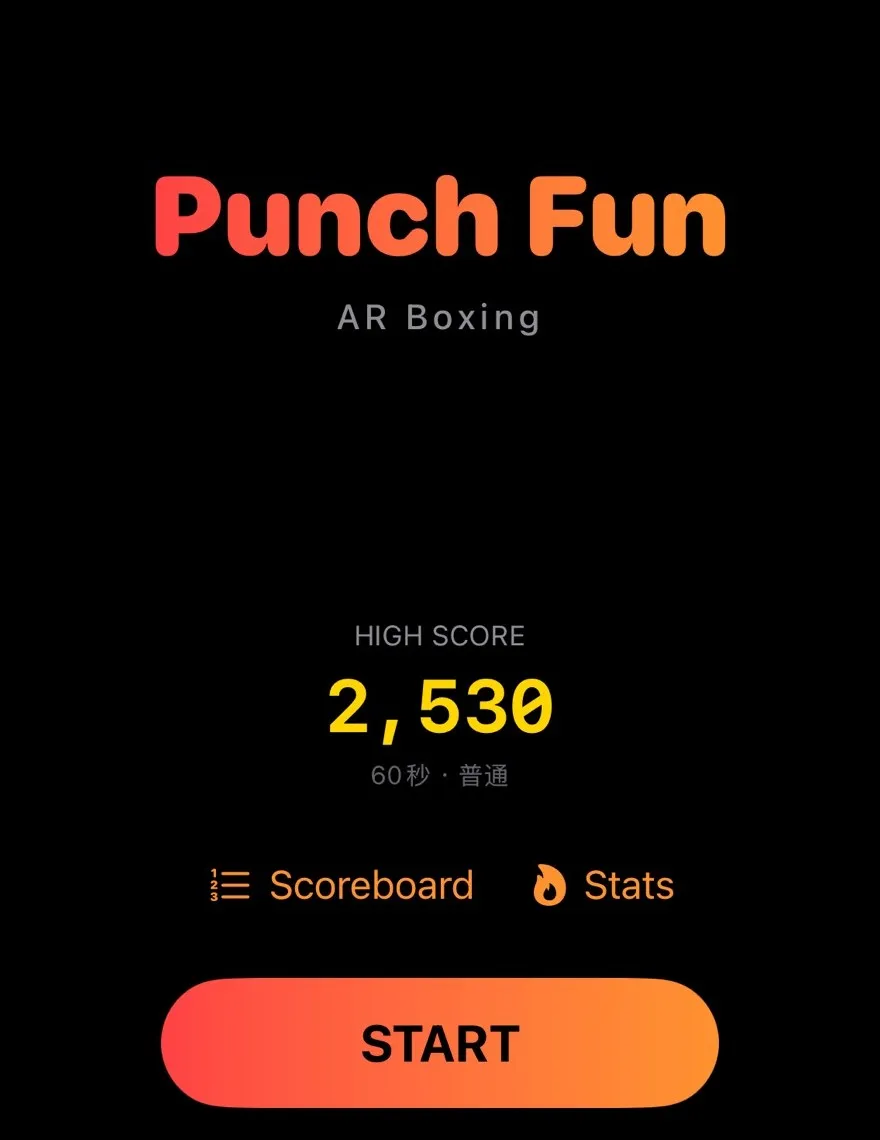
Round length, difficulty, one big button — the whole decision fits on this screen.
I want to single out the 30-second floor. It is short enough that it barely registers as “an activity you scheduled”: no resolve required, nothing to put in a calendar. When something is short enough to do on impulse, it happens at a completely different rate than something that needs scheduling.
But the fun cannot be fake
Why make fitness into a game instead of a list of exercises?
Because the payoff from exercise is delayed — better cardio, changed body composition, all of it weeks away — and people are bad at waiting for delayed rewards. Multiple studies keep finding the same thing: of those who start an exercise programme, a substantial share drop out within a few months. Gamification’s job is to insert a reward you can get right now between “this is tiring” and “this will pay off later”: you landed it, the combo multiplier climbed, this round scored higher than the last.
But this has a boundary, and I think the boundary matters.
Plenty of fitness products use streaks, leaderboards and constant notifications to “retain” users. It works short term, and the side effect is that exercise turns from something that makes you feel good into a task you must not break: logging a session while injured, pacing around the room at midnight to close a ring. The moment the game goal overrides the health goal, the product starts serving its retention rate instead of you.
Punch Fun does not go that far: it records combos and stats, but it sets no coercive streaks and it does not nag you. Open it when you feel like moving; leave it alone when you don’t. That is closer to what “light fitness” should mean — it should be available whenever you need it, not make demands of you in return.
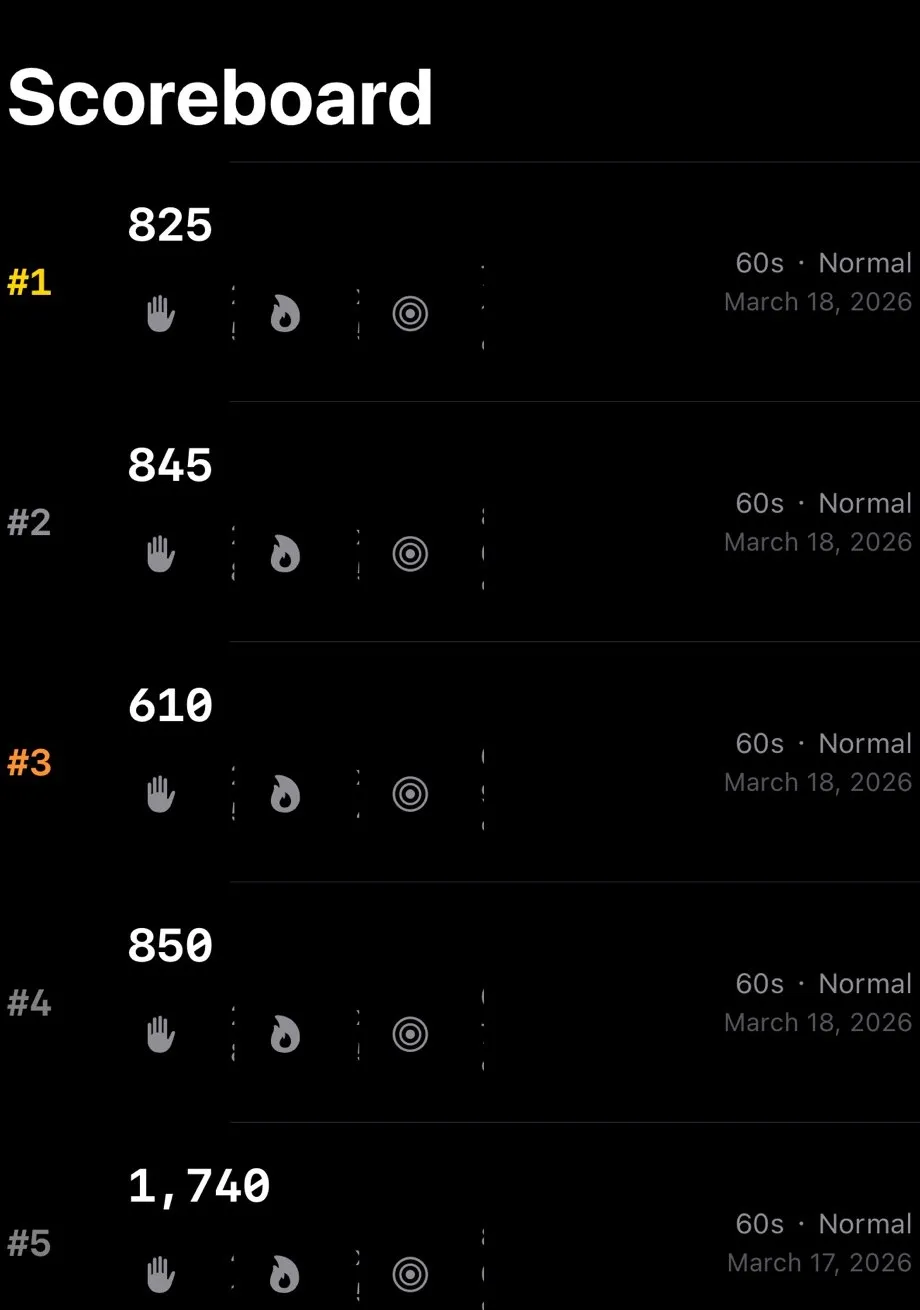
Every round is kept: score, duration, difficulty, date. The comparison is against your own past, not against someone’s streak count.
On calories, better honest than precise
Throwing punches is real movement, so burn can be estimated. Punch Fun uses a MET-based (metabolic equivalent) estimate — derived from movement intensity and duration, not claiming to be a measurement.
That distinction is deliberate. Without a heart-rate strap and lab equipment, any precise-sounding “you burned 137 kcal” is only an estimate. Labeling an estimate as precise looks better short term and spends trust long term. So it gives an honest estimate — enough to know roughly how much you moved this round — rather than a number wearing fake scientific precision.
One thing I took away
The core of light fitness is not “a lighter workout plan”. It is stripping away the overhead, layer by layer:
No particular place to go, no gear to buy, no change of clothes, no block of time to reserve, and no streak you are not allowed to break.
Strip it all away and what remains is only the movement itself — stand up, throw a couple of punches, catch your breath. And it is precisely once the threshold gets that low that “move a bit today” becomes, for the first time, easier than “skip it today”.
Convenient. Anytime. Those two words sound plain, but they may be the only version of fitness that holds up over years.