The Marble Maze Board I Played as a Kid, Now on a Phone
There was a wooden board toy I played with as a kid: a wooden frame, walls inside it like a maze, a steel ball, and two knobs. You turned the knobs to tilt the board one way or the other and rolled the ball from the start to the goal — with a dozen or so holes along the way, and falling into one meant starting over.
It had not a single electronic component and its rules took thirty seconds to explain, yet it could pull you back for round after round. Years later I built that same thing as an iPhone app (Level Ball). This is what I figured out between that wooden board and that phone.
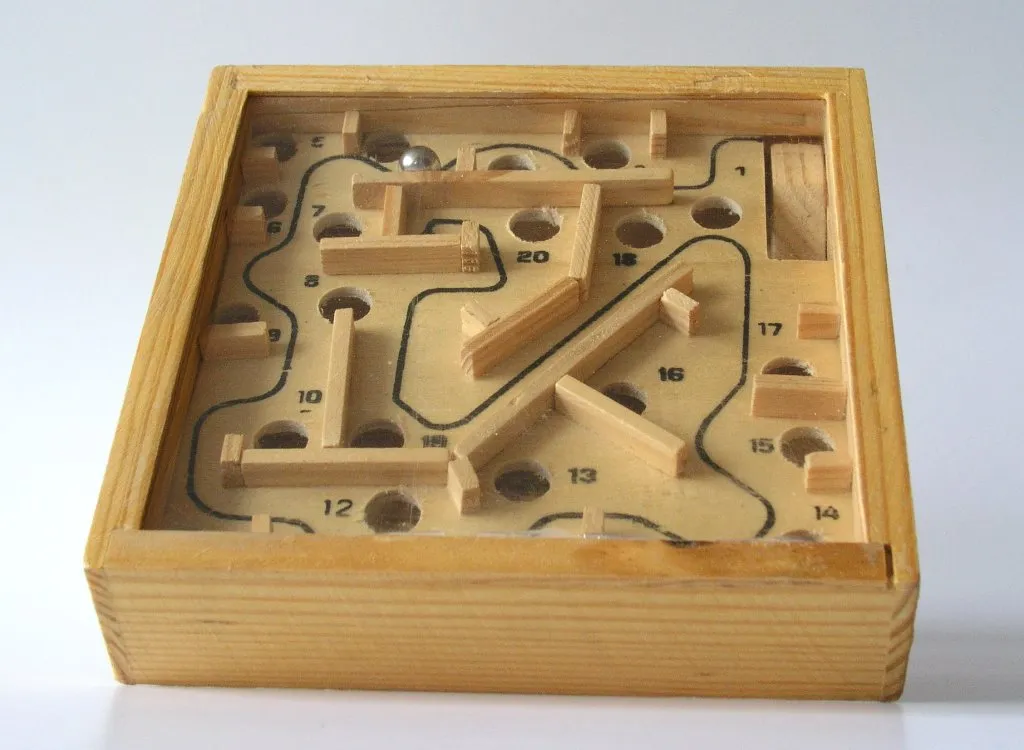
A classic wooden ball-in-a-maze board — wooden frame, maze walls, numbered holes, and a steel ball ready to drop into one. Photo: Andreas Röver / Wikimedia Commons, CC BY-SA 3.0

This board is far older than I assumed
I looked up where it came from, and it turns out to be much older than I thought.
In February 1889, a toymaker in Waverly, New York named Charles Martin Crandall made a little thing called Pigs in Clover: a round wooden tray with concentric rings of cardboard forming a maze, and a “pen” at the centre. The player had to drive 10 marbles — the “pigs” — into the pen without touching them with a finger. On 10 September that year he was granted patent US 410,956, titled simply “Game or Puzzle”. In the 1889 Montgomery Ward catalogue it sold for ten cents.
Then it went viral. According to the local paper, the factory was turning out eight thousand a day and orders were still twenty days behind; people were hunched over it on buses, in the street, on park benches. In March 1889 Senator Evarts carried one into the Senate chamber, a colleague borrowed it, a group of them started competing around the desk, and someone was sent out to buy five more. Newspapers even ran a cartoon at President Harrison’s expense — “will he be able to get all these hungry pigs into the official pen?”
The Chicago Tribune complained at the time that dinners were going cold, young ladies were not getting dressed for the theatre, business was paralysed, and clerks were dozing at their desks after sleepless nights.
I read that twice. Because it is almost word for word what people say about mobile games a hundred and thirty years later.
The idea of “balance” only arrived in 1946: Swedish designer Sven Bergling built a prototype in the early 1940s, and the Swedish toy company BRIO put it into production. It added two knobs and a field of trap holes — the ball drops into a hole and the round is over. Some people call this class of object “an unplugged precursor to video games”, which I think is about right.
Why a wooden board can be addictive
I have since thought about where the fun actually comes from, and it boils down to three plain things:
- Feedback is immediate. Turn it a little, the ball moves a little — no loading, no animation, no “please wait”.
- Failure is cheap. Drop into a hole, pick it up, start again; twenty seconds later you are clean again.
- A round is short. It is not “grind to max level” — it is “can I get through this time”.
The third one matters most. It is inherently a finite toy: one board, one ball, a twenty-minute session. You cannot play it all day, and you do not need to.
That finiteness is something I kept — which is why the app has fifty handcrafted mazes and a timer, rather than an infinite pool of generated levels.
On a phone, tilt is not the hard part
A gyroscope gives you the phone’s orientation, which looks like a natural match: tilt the phone one way, the ball rolls that way.
But the real difficulty is not “how do I make the ball move” — it is “what counts as level”.
A wooden board is something you can feel: the resistance of the two knobs, the friction of the wood, the faint hum of the ball rolling — all of it telling you how steep the slope is right now. A phone is a flat slab of glass. You play lying down, slouched on a sofa, one-handed on the train, and “level” is different in every one of those postures, while the screen gives you no tactile hint at all.
So what shipped has two tilt references and several sensitivity levels: one uses “phone held flat” as the reference, the other uses “whatever posture you were in when you pressed start”. That is not a fancy feature — it is the product of this exact problem.
One more thing a screen cannot reproduce: the moment the ball drops into a hole, on wood you hear it roll to the bottom and you feel that little drop. On the phone I used haptic feedback as a stand-in. Vibration does not replace the feel of it, but at least a mistake gets some kind of physical confirmation.
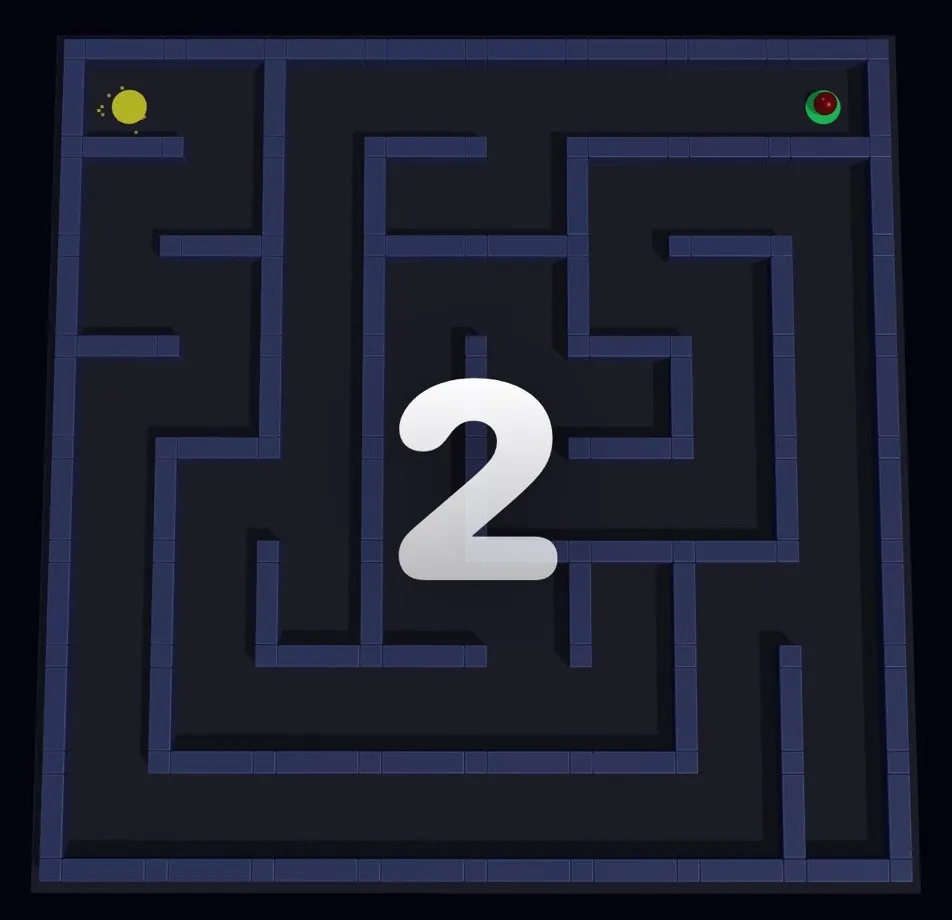
The same maze, moved onto a screen: the ball (top left) has to reach the goal (top right), with walls and holes between.
What a board cannot do
In the other direction, there are things a screen does that no board can — and those are exactly why I wanted it as an app:
- Levels can keep being added, with no need to tool up a new board
- Timing and records come for free — in the board era, you and whoever was next to you were the only record of “how long did that take last time”
- No ball to retrieve. It sounds like a joke, but play a wooden board for six months and you will lose at least one ball.
So the app ships with fifty handcrafted mazes, a timer, and it runs completely offline.
One thing I took away
Moving a hands-on toy onto a screen looks like a change of control scheme, but what does not survive the move is the feedback channel: force, friction, sound, weight. Lose any one of them and you lose a piece of the feel. All you can do is compensate with other things — vibration, sound, a clearer reference setting — and accept that it will never be whole.
That may also be why, all these years later, that wooden board is still given as a gift. It was not defeated by being digitised — it is still, after digitisation, a thing you hold in your hands.